

Let’s be honest: the world of DAOs feels like the wild west. A thrilling, open frontier of collective action and innovation. But just like any frontier, it’s got its share of uncharted territory—and, increasingly, sheriffs showing up to town. For anyone contributing to a DAO, whether you’re a developer, a token holder, or an active voter, understanding the regulatory landscape is no longer optional. It’s essential.
Here’s the deal: regulators worldwide are scrambling to figure out what a DAO even is. Is it a general partnership? A corporation? Something entirely new? That lack of clarity creates a fog of uncertainty for contributors. This article is your map—or at least, a decent compass—to help you navigate that fog.
The Core Dilemma: What Are You, Anyway?
This is the million-dollar question, honestly. And how a regulator answers it dictates everything—taxes, liability, securities law, you name it. DAOs are, by design, fluid and borderless. Regulators… are not. They need to fit things into existing boxes.
The Partnership Problem
This is the most common—and most risky—classification looming over many DAOs. In the U.S., for instance, if a group of people come together to make a profit and aren’t formally incorporated, they can be seen as a general partnership. The kicker? In a general partnership, each member can be held jointly and severally liable for the group’s debts and legal issues.
Think about that. If a DAO you contribute to is sued, your personal assets could be on the line. That’s not a theoretical risk anymore. Several court cases have already leaned into this interpretation, sending shivers down the spines of active contributors.
The Securities Sword of Damocles
Then there’s the Howey Test—the SEC’s framework for determining if something is an investment contract (a security). If a DAO’s token is sold with the promise of future profits derived from the efforts of others, well, it might just be a security in the regulator’s eyes.
This isn’t just about the DAO itself. It implicates token listings, fundraising mechanisms, even how you talk about the project’s future. The messaging matters.
Key Risk Areas for DAO Contributors
So, as a contributor, where might you personally feel the heat? Let’s break it down.
Tax Obligations and Reporting
Tax authorities don’t care about decentralization. They care about income and assets. For you, that means:
- Token Rewards & Airdrops: Receiving tokens for work or participation is likely taxable income. You need to know their fair market value on the day you receive them.
- Staking/Yield: Rewards generated are typically taxable events. The record-keeping can be a nightmare.
- Capital Gains: Selling or swapping tokens you hold? That’s a capital gains event. Tracking cost basis across hundreds of micro-transactions is, frankly, a huge pain point.
Liability Exposure
We touched on the partnership risk. But liability can also stem from:
- Code Vulnerabilities: If a smart contract you helped write or approve gets exploited, could you be liable for losses?
- Regulatory Actions: If a DAO is deemed to have broken securities laws, active governance participants might be seen as culpable.
- Content & Curation: For media or social DAOs, what’s the liability for posted content? It’s murky.
Navigational Tools: How to Mitigate Your Risk
This all sounds daunting, sure. But you’re not helpless. There are strategies—both for DAOs and for you as an individual—to chart a safer course.
For the DAO: Structural Shields
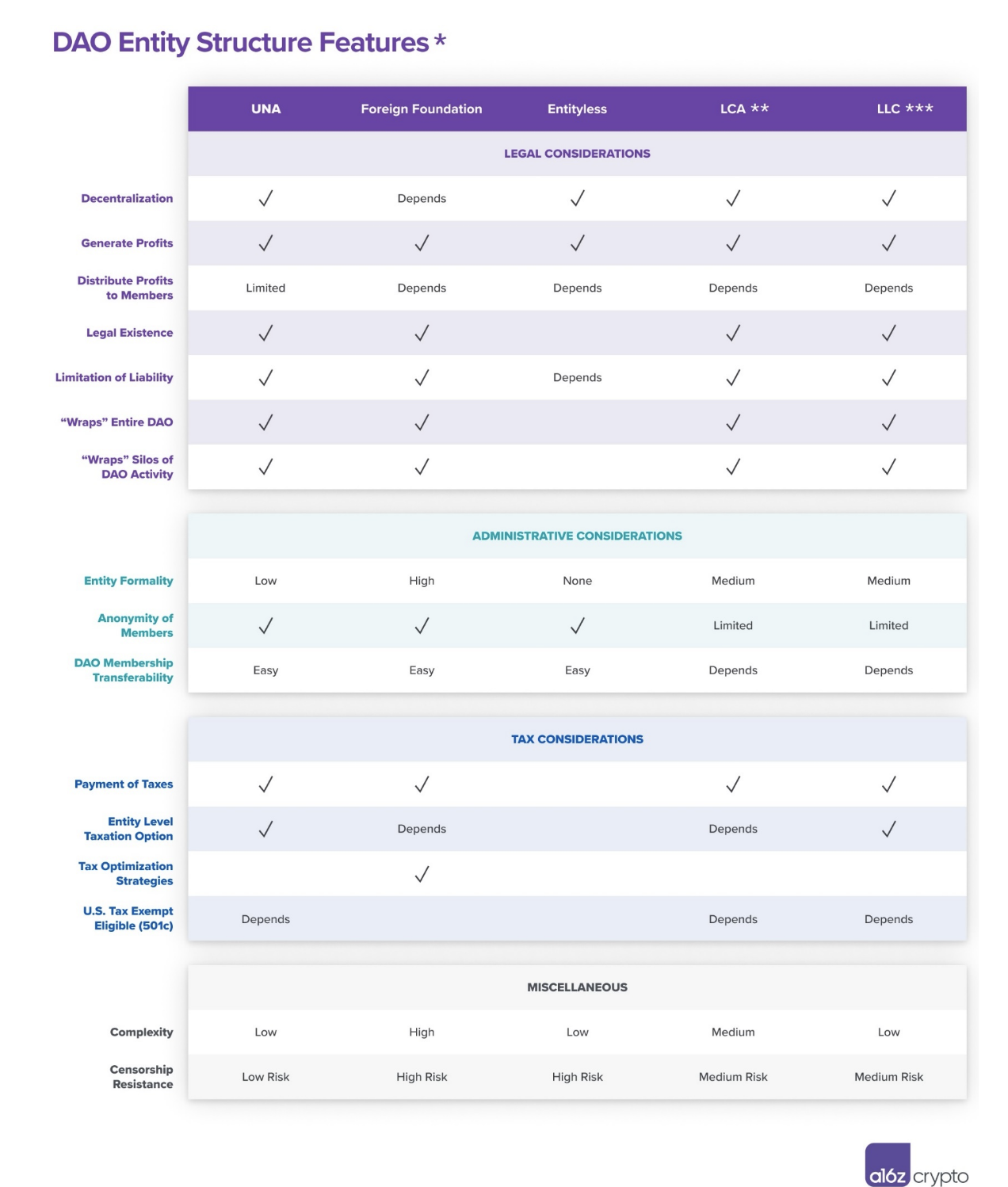
Forward-thinking DAOs are exploring legal wrappers. It’s a bit like putting a spacesuit on a Martian—it allows the alien entity to operate in our earthly legal atmosphere. Common options include:
| Structure | Primary Benefit | Trade-off |
| Wyoming DAO LLC | Explicitly recognizes DAOs, limits member liability. | U.S.-centric, requires registration and an agent. |
| Cayman Islands Foundation | Familiar to crypto projects, provides a legal identity. | Can be costly, may centralize some control. |
| Swiss Association | Simple, non-profit friendly structure. | May not fully encapsulate for-profit activity. |
| Delaware LLC | Well-trodden path, flexible. | Not DAO-specific; mapping roles can be awkward. |
For the Contributor: Personal Best Practices
Your own actions matter. Think of it as digital hygiene.
- Do Your Due Diligence: Before you dive into a DAO, look at its docs. Does it have a legal wrapper? What does its disclaimer say? If it’s purely “code is law” with no legal mention, understand that risk.
- Document Everything: Keep meticulous records of your contributions, token receipts, and transactions. Use crypto tax software. When the taxman comes, good records are your best defense.
- Diversify Your Involvement: Be mindful of how much time and value you pour into a single, unshielded DAO. Spreading your involvement can, in a way, spread your risk.
- Seek Professional Advice: I know, it’s expensive. But consulting with a crypto-savvy lawyer or accountant once can be cheaper than the fallout from getting it wrong.
The Horizon: A Patchwork of Global Approaches
Regulation isn’t monolithic. It’s a patchwork quilt, and the patterns vary wildly. The U.S. is taking a more aggressive, enforcement-first stance. The EU, with its MiCA framework, is trying to create a comprehensive rulebook—though how DAOs fit is still being worked out.
Meanwhile, places like Singapore, Switzerland, and the British Virgin Islands are crafting more tailored, perhaps welcoming, approaches. This divergence creates both challenges and… opportunities. It forces the community to think harder about legal design.
The path forward is messy. It’s a dialogue—sometimes a shouting match—between a revolutionary technology and centuries-old legal systems. For DAO contributors, that means staying agile, informed, and a little bit cautious. The goal isn’t to kill the decentralized spirit. It’s to protect it, and you, so it can endure and actually build the future it promises.